Category Archives: Feminism

Remembering Betty Ford

I learned today of the passing of former First Lady, Betty Ford. Sometimes it’s not until death that someone’s contributions are apparent. To me, Betty Ford was synonymous with the rehab treatment center that bore her name. I didn’t realize all the other ways in which she was influential.

As a young woman, Ford, born Elizabeth Ann Bloomer, worked as a model, dance teacher, and fashion coordinator at a department store. The style  and grace that landed her those positions was evident throughout her entire life in photos and interviews I’ve seen. But beyond the polished exterior, was an honest, genuine, and open woman.Betty Ford

She divorced her abusive, alcoholic first husband after five years’ of marriage. That step alone was a brave action—expecially for the mid-20th century. She married Gerald Ford, shortly after he entered his first term as a member of the U.S. House of Representatives.

She entered the White House as First Lady in 1974, as a stay-at-home mother of four children, but she quickly shattered perceptions of what a stay-at-home mom should be.

Shortly after becoming First Lady, Ford announced to the world that she was battling breast cancer. Her announcement was a huge win for women’s health. It seems strange today, with all our pink ribbon campaigns and events, but in the early 70s, breast cancer wasn’t talked about publicly. As a result of Ford’s candor, many more women began getting mammograms, funding for breast cancer research gained momentum, and the disease lost its taboo.

Betty Ford was also a feminist and supporter of the Equal Rights Amendment. She was an activist in the women’s rights movement, and spoke out on controversial topics—from equal pay to abortion. She didn’t let her husband’s high-profile job silence her.

At a time when substance abuse carried a stigma, Ford shared her own struggles with alcohol and prescription painkillers. In doing so, she affected millions of people and helped change the way we view addiction.

Although she never ran for office, she had a high approval rating and lobbied for the Supreme Court to have a woman on it. When her husband lost the presidential election in 1976, she gave his concession speech. They were very much equals and partners. Gerald ford once said, “I am indebted to no man and to only one woman, my dear wife.”

From humble beginnings, to a position of national power and influence, Betty Ford never lost her sense of who she was. She wanted to make the world better, and she did. Throughout her life, Betty Ford was active in women’s rights and continued a public life with speaking engagements and as an advocate for the arts. Although she had struggles (addiction, cancer), she lived the life she wanted, spoke her mind, and contributed to social change. She was married to the love of her life for 58 years. She was 93. Her’s is a life worth celebrating.

As a woman who started with humble beginnings and rose to become such a high-profile figure, I think Betty Ford fits this month’s Feminist Fashion Bloggers‘ theme: Fashion, Feminism, and Social Class. Have a look at what the others are writing about.

Sources:

http://en.wikipedia.org/wiki/Betty_ford

NBC Evening News, July 9, 2011

ABC News Online “Former First Lady Betty Ford Dead at 93” by Christiane Amanpour

5 Comments

Filed under Feminism, General

Feminism in the Media

This month’s Feminist Fashion Blogger group post is about feminists in the media. It’s timely; I was reading the June edition of Glamour, the F-word was printed twice, in two interviews by two very different women.point of view

The first instance was in an interview with Rachel Maddow, host of MSNBC’s The Rachel Maddow Show. Rachel is asked (by Katie Couric) if being gay influences what topics Maddow chooses to cover on her show. Maddow smartly replies that she’s never done the show as a straight person. The interview turns to how being a woman (in general) might influence the stories they cover.

Rachel responds with, “But if you were a feminist dude, maybe you’d make the same decisions. And if I were a pro-gay-rights straight person, maybe I’d make the same decisions, too. I don’t feel there’s anything about my experience of being gay that gives me more insight into “don’t ask, don’t tell,” for example. What does, is my understanding of the military. (p. 171)”

Later, in an interview with cover model Oliva Wilde, I read the second instance. Wilde, an actress, is talking about how she never wanted to become a journalist like her parents, Leslie and Andrew Cockburn. She goes on to say, “I can’t tell you how profound it’s been to realize that [my mother] is so within me…She’s gorgeous, and she taught me that a real feminist doesn’t apologize for her beauty. You can be a sexy, gorgeous woman, and be the smartest person in the room. (p. 186)”

Several things about these quotes made me smile. First, Glamour is interviewing smart women who unabashedly use the F-word. Second, by saying “if you were a feminist dude” Maddow raises the idea that feminism is open to everyone. It’s said casually, and in a positive tone that I hope will help readers of the magazine accept the idea of feminism in all forms (if they don’t already).

Finally, Wilde is a different type of role model for young feminists. She is reconciling the different parts of one’s self and saying you don’t have to look or act a certain way (or it’s okay if you do) to be a feminist. For readers who might think being feminists means giving up dresses and nail polish, I think Olivia subtly changes that perception.

Perhaps both of these mentions are incidental, but I found it encouraging and refreshing to read about these two women and see in print that they’re not afraid to speak honestly about feminism.

For everyone else’s posts about feminists in the media, check out the FFB blog.

8 Comments

Filed under Feminism

Guest Blogger: Deb of Real Girl Runway

I’m Deb of Real Girl Runway and I’m so happy to be guest blogging here today on Jean of all Trades.  Jean and I have arranged to switch blogs today through the Feminist Fashion Bloggers group.  Make sure to check out Jean’s post on my blog here.

I am so fortunate that I’ve had so many wonderful women who’ve influenced my life and my style.  When it comes to fashion, some of my biggest influences came from my family.  I come from a long line of stylish women.  My Mom has amazing personal style as does my Aunt.  I love looking at pictures of my family from bygone eras.

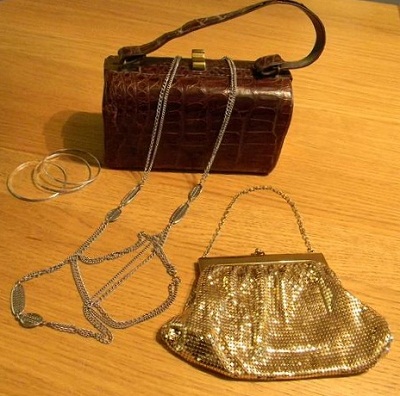
Long Necklace

My mom always encouraged me to be myself.  She is a very classic dresser but I’ve always been a more on the adventurous side.  She suffered through my crazy punk, 80’s teen years, full of crazy combinations, studs and spiked hair.  Even if Mom didn’t like something that I was wearing, she always had something positive to say.  She helped me to refine my personal style and to be unique but appropriate for all occasions.  She taught me everything I know about remixing.  When we would shop and I’d find an item I loved, her first question was always, what else do you have that you can wear that with?  She encouraged me to stretch my dollar and taught me how to bargain shop.

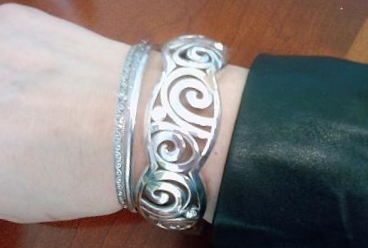
bangles

One of the most important fashion lessons my mom ever taught me was how to walk in heels.  When she bought me my first pair of heels, she made me practice.  She explained about the ways to walk gracefully and take smaller strides.  She showed me that clomping and stomping in heels just looked clumsy and not pretty.  It’s a lesson that’s stayed with me my entire life.  I’m not a petite Sarah Jessica Parker size. Learning how to walk in heels as a tall, plus size girl was important.

I’ve learned so many great style lessons from the women in my family.  There are too many lessons to count but here are a few:

  • Fit is the most important thing.  If you can’t alter it yourself, find a good tailor.
  • When you buy an item, think of your closet and how you can mix and match it in the future.  Buyer’s remorse is never fun.
  • Great jewelry and accessories can make or break an outfit.
  • Take off your makeup every night and moisturize.
  • Always be yourself.  Expressing yourself through your clothes is a must.

Vintage items from My Mom

Some of my most cherished fashion pieces are accessories given to me by my Mom.  They are items that she has owned for many years and I always admired.  I’ve worn some of them in my posts.  I remember Mom carrying her gold Whiting & Davis bag to parties when I was very young.  I always loved it and was so excited when she gave it to me.  Every time I wear something that belonged to her, it brings back wonderful memories.  The items that she’s given me are wonderful but the lessons are priceless.

2 Comments

Filed under Fashion, Feminism

Money Changes Everything

This month’s FFB group post is about Finance, Fashion, and Feminism. Don’t forget to check out all the other posts.

Money. It’s the root of all evil. It’s time (or is time money?). It can’t buy you happiness. There are lots of quotes and advice about money. Here’s what I know: Money changes everything.

Yes, that’s the title of a Cyndi Lauper song (originally performed by The Brains but popularized by Lauper). Have a listen when you get a chance.

I learned a lesson about money when I was about five years old. I’d seen my dad leave the house every day to go to work, and I saw him pay for things. He gave my mom money to buy things (she worked too, but my dad made more and that’s what affected me as a child), he bought things, he bought things for me.

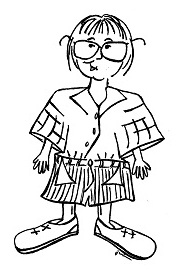
Sign me up! One day, I put on my dad’s corduroy shorts, his short-sleeved plaid shirt, an old pair of his glasses frames, and even his giant shoes. I must have looked hilarious. But I took it a step further: I carried an old wallet and got my mom to put some money in it. We went to the mall, where I had her call me “Doug.” I paid for everything that day. And I was hooked. I’ve been wearing the proverbial pants ever since. Please don’t analyze that scenario! Freud would have a heyday with it. But I digress.

Money is freedom. I’m not really a materialistic or greedy person, but I know the value of money. I’ve worked since I was 12. Babysitting, short-order cook, retail sales, you name it. I worked through university, and still do. I don’t live to work, but earning money is a safety net. I’ve built a career in a field that I enjoy and that pays far above the national average.

Earning my own money protects me. I’ve seen women have to ask to buy things or hide purchases from their husbands. Not me. I have my own money and manage my own finances. If I buy shoes, my husband doesn’t complain. If he buys drinks for the entire restaurant, who cares? We have one joint account for common expenses, such as mortgage and the phone bill. That’s it. The rest we keep separate. That doesn’t work for all couples, but it works for us.

I also feel that earning power is important for other reasons. I understand compound interest and the value of investing and I’m planning for my future. I like to shop, but I also like to be thrifty and look for sales and second-hand clothing. Fashions change; money is always in style.

I can speak my mind without worrying about getting cut off (I know some people who can’t disagree with their parents or spouses for fear of losing an income stream). I have an emergency fund in case I get injured, sick or laid off. Extra money also means I can leave a job if I have to (and I have). If I’m not being treated right, I don’t have to put up with it.

I’m lucky to have never been in situation where I had to flee my partner, but without money, it wouldn’t be easy to get out and on my own.

Understanding money, having a financial safety net, and making money are feminist actions. The majority of people in the world who live in poverty are women. Now that’s a complex issue for another post, but it drives home the importance of education, equality, and financial independence.

When women have rights and opportunities, they become better educated and in turn contribute to their own success and the success of their communities. They also have better access to family planning and are less likely to live in poverty. Raising children, while important and noble, is a huge financial burden that often sets women back financially. Child-rearing can often interrupt education and careers, and it’s expensive. The need for financial security is even more important for women who raise families.

Women are often paid less than men and are discriminated against in the workplace. 70% of the world’s poor are women. And even right here in the US, over half of Americans living in poverty are women. There are twice as many women over 65 living in poverty as men.

It sounds grim, and it is. But arming ourselves with education and a financial safety net is a good start. Then, we need to continue to fight for equal pay, access to high-paying jobs, affordable child care, available contraceptives, and support and protection from violence—for ourselves and all of our sisters. Simple!

Sources:
http://www.unifem.org/gender_issues/women_poverty_economics/
http://www.americanprogress.org/issues/2008/10/women_poverty.html

8 Comments

Filed under Feminism, General

The Art of Feminism

Last week, I almost walked into Gloria Steinem’s office.feminist t-shirts Well, almost.

See, I was wandering around Seattle taking pictures of people when I came across a couple of stylish guys in front of an art gallery. I asked to take their picture, and they kindly obliged.

What I neglected to do was enter the gallery and check out the exhibit. When I arrived home I went to the gallery’s site and found, to my surprise, their current show is a feminist retrospective titled “Art and Artifacts from the Office of Gloria Steinem.”

Needless to say, I returned to Form/Space Atelier the following week to see what I had missed. The gallery is a small space, tucked into the lobby of the Low Income Housing Institute. The exhibit includes objects gifted to the gallery by the office of Gloria Steinem. It was as much a gallery as it was a museum.

An installation piece at the entry displayed an old typewriter with a seemingly endless roll of paper feeding through it—and I’m sure that’s how it felt to begin letter-writing campaigns—an endless job. The piece included two chairs with two coats hanging over them—to me, that represented the collaborative nature of the office.

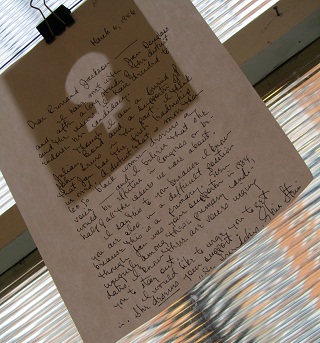
letter to Jesse JacksonI saw copies of letters Gloria Steinem wrote to people such as Jesse Jackson, and I saw prints of the iconic power stance of Steinem and Dorothy Pitman. Seeing the two women, whose backgrounds are very different, working together at the intersection of civil rights, women’s rights, and community activism helped me see the feminist movement as more inclusive than people give it credit. It reminded me that women’s rights are important to everyone and the results benefit the community—and country—as a whole.

As a quick primer, Steinem and Pitman cofounded the Women’s Action Alliance in 1971 and are longtime friends and speaking partners. They both work tirelessly to fight sexism, racism and classism.

Dorothy Pitman Hughes is a writer, speaker, activist and a lifelong champion for women, children and families. She organized the first battered women’s shelter in New York City.

Gloria Steinem is a writer and best-selling author, lecturer, editor, feminist activist and organizer, and co-founder of Ms. magazine.

I’m glad I had a chance for a do-over. I went back to see what I missed the first time I walked past the gallery. The experience reminded me to keep my eyes open and see the signs of art and feminism and community collaboration that are all around me.

The show runs through April 17th.

This is a fifth group post organized by the Feminist Fashion Bloggers. To see what others wrote, check out their posts.

Sources:
http://www.formspaceatelier.com/index.php
http://liftdontseparate.org/about.html
http://en.wikipedia.org/wiki/Gloria_Steinem
http://jacksonville.com/ “Q&A with Author and Activist Dorothy Pitman Hughes” by Cristin Wilson, Jan 27, 2011

14 Comments

Filed under Art, Feminism

The Politics of Pants

I’m wearing pants to work today—mainly because I can. Women’s clothing is often political and I’d like to look at a few examples throughout history. Some of it recent. This post is the fourth installment of the Feminist Fashion Bloggers weekly posts celebrating Women’s History Month.my pants Check out what everyone else wrote about.

To this day, many women around the world aren’t allowed to wear pants. As recently as 2009, Sudanese officials handed out corporal punishment to thirteen Sudanese women; the women were arrested in a restaurant in the capital, Khartoum. They received 10 lashes each for their crime of wearing pants.

Ah, but that’s a different culture, you say. True, but not until January 1995 did the California legislature actually prohibit employers from implementing a dress code that does not allow women to wear pants in the workplace. That means, before then, employers could tell women “dresses only” and there wasn’t a damn thing they could do about it.

It’s not fair to make generalizations. Throughout history and in different cultures, clothing has changed a lot. For most of history, men didn’t wear pants either. They wore robes, tunics, kilts, dolmans, hakama, dhoits, sarongs, the fustinella, you get the idea. When men wear “skirts” (outside of the west—with the exception of kilts), it’s not seen as feminine. But when women wear pants, it’s perceived as somehow upsetting the whole balance of things.

However, the horse-riding peoples—men and women—of the Persian Empire wore pants as early as 600 BCE. Koreans of both genders wore pants as early as the 15th century. Many Native Americans wore leggings too.

Other women throughout history have been mocked and persecuted for their adoption of “men’s clothing.” Joan of Arc was known for wearing pants; she traveled with the army and wore their attire. She wore pants in prison and was said to have been executed in them. A few weeks ago I wrote about Qiu Jin, modern China’s first feminist. She chose to wear men’s clothing, much to the chagrin of onlookers.

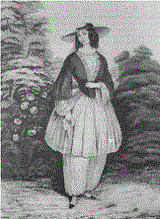
BloomersIn the west, pants had a hard time getting a foothold.

Amelia Bloomer gets the credit, but Elizabeth Smith Miller created bloomers. These women were involved in women’s rights, temperance, abolition, and were social activists. They were also ridiculed by their attempts to reform women’s clothing.

During this time, some women advocated other changes too, such as simplified garments for bicycling or swimming. The availability of inexpensive bikes helped women gain independence and created a need for more practical clothing. Corset controversy began (and in China, Qiu Jin was unbinding her feet and fighting against that practice).

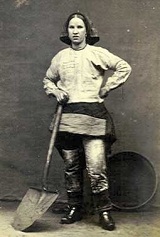
Nineteenth century coal-mining girls wore trousers, and throughout the world warWigan Pit Brow Lasss working women donned slacks—but they didn’t come into fashion until later. Marlene Dietrich and Katharine Hepburn caught the world’s attention by wearing pants. Audrey Hepburn popularized capris. The 1960s introduced us to bell bottoms. The 1970s brought us pantsuits, and the rest is herstory.

Pants are political. As much as I like dresses, I am thankful for pioneers who fought for the right to choose one’s attire. Women’s clothing has been seen as a threat at so many points throughout history—and still is. Exercise your right today!

Sources:
http://www.csub.edu/library/gov/edocs/womenequality.pdf
http://news.bbc.co.uk/2/hi/africa/8147329.stm
http://en.wikipedia.org/wiki/Pants
http://en.wikipedia.org/wiki/Amelia_Bloomer
http://en.wikipedia.org/wiki/Bloomers_(clothing)
http://en.wikipedia.org/wiki/Women_wearing_pants

9 Comments

Filed under Fashion, Feminism

Feminism and Fashion

For the third installment of the Feminist Fashion Bloggers weekly posts celebrating Women’s History Month I’ve been asked to answer a question: How do you express your feminism in the way you dress?

Initially, I didn’t have an answer. Do I express my views through my clothes? Maybe fashion and feminism are two separate things to me, and never the twain shall meet.

To find out, I thought back to my childhood. It’s a bit hazy, so I went to a reliable source: my mom. I thought she would know how I started my love affair with fashion. I gathered up a few pictures she had taken of me as a child and started asking questions.A portrait of the author as a young girl

Turns out, from a very young age (say, 3 or 4), she let me pick out my own clothes. I’d shop my closet and mix and match things any way I wanted. I learned about what worked and what didn’t, and I wasn’t following anyone else’s rules. Maybe I shouldn’t have mixed two different patterns, but I did—and no one got hurt! My mom instilled in me a few ideas, one of which is not to worry about what others think. Another is to do things I want to do, not things other people tell me I should do.

She told me a story about how when shopping for winter boots, I picked out a pair that she found atrocious. She steered me to a more practical pair and gave me reasons for choosing them. I looked her in the eye and sweetly stated, “But Mom, I have my own taste.” That sealed the deal. She thought that—despite being 5 years old—I was right. I wasn’t her. I was me. I had different tastes in fashion—and that’s okay. And, I got the boots!

I remember them well. An auburn faux-fur shaggy pair of boots that looked like Bigfoot’s actual feet. I loved them! Sure I had to comb out the snow every day, but I wouldn’t have traded them for the world. And to be honest, if I found a pair in my size today, I’d buy them.

I believe dressing for myself boosted my confidence and gave me a feeling of independence. I had a creative way to express my individuality. Thinking for myself and knowing what I wanted helped me in many ways. I grew up without succumbing to (too much) peer pressure. I learned to speak up for myself and not worry about what “people might think.”

I was lucky that in high school, I was allowed to cut and color my hair and try crazy clothing combinations. I didn’t dress “for boys.” They could like me or not, but my funky wardrobe and I were a package deal. I never could stomach the “dress sexy for your man” articles I see in magazines.

I have pretty diverse fashion choices. I’ve had long hair and short hair, blond, brown and red hair. I can dress up or down, dress girly or tough, and I can use clothing to express my moods. I’m not sure men “get” my clothing choices. My husband recently confessed that he thought I was color blind for the first few months we dated. I took that as a compliment. An unexpected color combination might not be a turn on, but I think I deserve points for originality. Perhaps my wardrobe—and it’s lack of short-and-tight numbers—has acted as a filter to weed out the more shallow guys I’ve met.

I enjoy clothing in an artistic way. Mixing colors and creating textures and shapes with the space I have to work with describes both how I paint and how I wear clothes. I enjoy being creative and having fun. Art and fashion provide that outlet. I don’t have time to paint every day, but I have to wear something, so I challenge myself and enjoy the process.

I’ve come to the conclusion that I express my feminism in the way I dress by dressing for myself.

~

Check out all the other cool posts at Mrs Bossa’s site. Scroll to the end (after you read her post, of course) and you’ll see a list of links to all the other FFB pages.

8 Comments

Filed under Fashion, Feminism

Qiu Jin: Modern China’s First Feminist

A woman without talent is virtuous.

That’s the world Qiu Jin was born into. And it was a world she was determined to change.

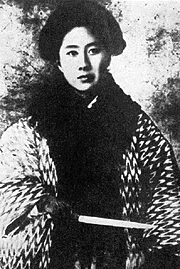
Qiu JinI learned about Qiu Jin this week during one of the many Women’s History Month events my company is hosting. I attended a screening of “Autumn Gem: Modern China’s First Feminist,” a documentary directed by Rae Chang. I am participating in the Feminist Fashion Bloggers second group post, and knew Qiu Jin would be a great subject to share. Here’s what I learned while watching the 56 minute film:

Qiu Jin is well-known throughout China and is considered a hero and a martyr. Outside the country, she is less well-known. She was born in 1875 to a privileged family. Her brother had a private tutor and as a young girl, Jin would often sit nearby and watch him learn.

In an uncommon move, the tutor remarked to Jin’s parents how smart she was—so they let her learn alongside her brother. During this time in China, most girls didn’t receive an education and many were illiterate; she enjoyed a childhood where she could learn and read and be active outdoors. Her father and uncle taught her martial arts. She read about Hua Mulan and other legendary woman warriors.

Her adolescence coincided with a tumultuous time in China’s history. Foreign armies invaded, the Opium Wars were over, but opium use was rampant, and the government was corrupt. But she couldn’t participate in change. She wed a stranger in an arranged marriage and was isolated from her family. During this time she was sad and lonely. She wrote poetry and had two children.

Inspired by women she’d read about—women like Sophia Perovskaya, Madame Roland, and Joan of Arc—Qiu Jin was determined to save her country. She believed that women needed to be independent and productive in order for China to be strong, defeat its enemies, and overthrow the Manchu government. But women didn’t even entertain the idea of a different life. She had to teach women to think differently. She once had bound feet, but unbound them and spoke against the practice, as well as against other things that kept women from being self-reliant.

Qiu Jin left her husband and children and set off to Japan where she met other Chinese intellectuals. She wore men’s clothing and loved freedom they provided. Many shunned her because of her attire and attitude. But people also listened. By the time she returned to China to overthrow the government, the Restoration Society she helped form was 50,000 people strong. The revolutionaries accepted her and she began training an army of women.

She wrote and published a Chinese woman’s journal where she encouraged women to become part of society. But Jin felt trapped by her female body. At a time when being a woman meant being subservient—not being a member of society, but an ornament for a husband—being female was a disadvantage. Jin felt she could accomplish more if she were a man.

Still, she plotted the uprising. However, her plot was revealed and she was arrested and publicly executed. She was 31. She didn’t succeed in that act of defiance, but her execution fueled the revolution. She was the first woman to die for the cause and she inspired other women to join the fight.

It’s impossible for me to grasp what life was like for a woman 100 years ago. Qiu Jin’s life was short and violent, and it’s hard to understand her experiences at the crossroads of feminism and nationalism. I do respect her dedication to her values. She was a strong woman who wasn’t afraid to speak her mind. She questioned the status quo and imagined a better world when others couldn’t. This year is the 100th anniversary of both International Women’s Day and The Chinese Revolution. It seems like a good time to acknowledge Jin and other pioneers of feminism who paved the way for others by fighting and dying for what they believed in.

~

See what the other Feminist Fashion Bloggers wrote about:

Sidewalk Chic – Reclaiming leather skirts and other ‘provocative’ clothing

Mrs Bossa – In Bad Company: Girl Tribes

Oranges and Apples – Some thoughts on Marthettes, blogging about ‘feminine’ stuff and perfection

The Magic Square Foundation – Body Policing/Fashion/Feminism

Alexa Wasielewski – Some Feminists Need to Spartan Up!

Fishmonkey – The Man Repeller and The Male Gaze

Knitting up the ravelled sleeve of care – Knitting a Better World

Interrobangs Anonymous – Millie’s Take on Modesty

Adventures in Refashioning – Soldering in Heels

What are Years? – My Thoughts on the CBC Documentary, The F-Word

Aly en France – My Body Entirely

7 Comments

Filed under Fashion, Feminism, Film

Karen J. Whitehead Talks about Her Film

Last month I wrote about an incredible photographer: Jini Dellaccio. In my post, I mentioned that someone is making a documentary about her life. Well that someone is Karen J. Whitehead. I sat down recently to ask Karen, the producer/director of the film, a few questions. (Be sure to and follow her production blog.)

(c) Five Star Films 2011

(c) Five Star Films 2011

Jean: How did you first learn about Jini Dellaccio?

Karen: A friend of a friend got in touch after coming across Jini’s photographs online – thinking (quite rightly) she would make a great subject for a film.

Jean: When did you approach her about a documentary and how did she feel about the idea?

Karen: I started doing some research for myself about the Northwest music scene in the 1960s, and Jini’s story, in the fall of 2009. After several conversations with the Jini Dellaccio Collection, which oversees Jini’s archive, I arranged a research trip to meet them and Jini in January 2010.

We spent several hours together, and as I listened to Jini describing some of her life experiences and passion for art and music, I was captivated and at the same time staggered that the world does not know who Jini is!

Jini was thrilled that I was interested in her life and artistry. We really made a strong connection, and I think she was immediately open to the idea of doing a film because I wanted it to be very much an intimate oral history. By that, I mean in her own words, (no narrator or scripted scenes), as she remembers the many decades of her creative journey and her personal background, with recollections of some of the musicians she photographed. From this, I felt the film could be a fascinating exploration of her relationship with her subjects as well as her fine art photography and how it is all underpinned by the importance of music and art in her life.

Jean: What parts of Jini’s life are you focusing on and how did you choose them?

Karen: A central part of the film is of course, behind the scenes of Jini’s rock ‘n’ roll photography in the 1960s. She was responsible for capturing the frenetic energy of live concerts by The Who, The Rolling Stones, Mitch Ryder, Mamas & Papas to name just a few – and she was doing this years ahead of Annie Leibovitz. But really the heart of the story is how Jini got to be shooting the Godfathers of garage punk rock (The Wailers/The Sonics) and other great Northwest bands like The Daily Flash and Merrilee Rush and the Turnabouts – in her middle age! Plus the tales from her Neil Young shoot and all the great concert photography she did with her beloved Hasselblad camera.

But it is also much more than that – I really wanted to craft a film that explores Jini’s creativity and determination. I think her life story from humble beginnings to jazz musician in the 1930s to her discovery of art and then self-taught photography is really inspiring. Especially when you consider she was often going against the grain, and conventional roles for the time. She was always in a man’s world, but not afraid to experiment, and be out there, in pursuit of her art. So, to give the audience an insight into this, I have Jini and other photographers, as well as the subjects of her lens, commenting on her work and I show her “at work” still in her 90s taking on a new challenge – digital technology, and shooting a new generation of rock bands coming out of Seattle’s vibrant music scene – The Moondoggies. When you see Jini working with The Moondoggies, almost 50 years from her first rock band shoot, I think you get the measure of Jini’s accomplishments and her legacy.

Jean: When creating documentaries, are there storylines that “write themselves” (unexpected narratives) or do you shape the film’s development?

Karen: That is a very good question! And the short answer is yes and no – or a bit of both!  Documentary is often about revealing unexpected narratives and in this case, I really felt that the rich cultural history behind Jini’s personal (mostly untold and unknown) journey as an artist would appeal to audiences. But of course, for audiences to really “connect” with your subject matter, you have to give them some compelling visuals and a simple rule but a golden one: good story telling, to keep them engaged. That is where the crafting of the narrative structure comes in. So, although there is no formal script as such – we build the filming around Jini’s  recollections and what she reveals about her motivations and life experiences. It is a collaborative process really – what you discover along the way may take you in different directions than you were expecting or planning – but it is important to have a structure like a road map so you don’t get lost in the edit!

Jean: What’s the most surprising thing you learned in the making of this film?

Karen: Some things Jini told me from her Jazz days in the 1930s were incredible, but I don’t want to reveal all the cool stories in the film here. Lets just say there are some “crackers” as us Brits like to put it!

Also – sideline, Seattle really does have some of the best coffee in the world…I am a definite fan!

Jean: Anything else you want to share?

Karen: Here’s something to think about:

“Storytellers broaden our minds: engage, provoke, inspire, and ultimately, connect us.” —Robert Redford

So, let’s make sure stories like Jini’s are not “lost.” Unfortunately, indie arts films like this are hard to make because we have fewer places to go for funding than other film projects. In the current dismal climate for arts funding, with threats to vital lifelines like the National Endowment for The Arts, it is increasingly up to individuals to engage not merely as an audience – viewing a finished product, but as a participator much earlier on in the process.

I want Jini’s artistic excellence, creativity and innovation to be shared with the world and that is why I put my passion and resources into this project. Although I was able to complete all essential filming with Jini, for the film to be complete – which includes editing and the specialised scanning and treatment of Jini’s vintage stills from the archive, the production is seeking funding from donors, industry sources and fellow believers in arts projects as a necessity not a luxury. Hopefully with support from Seattle’s vibrant arts community this film will be heading to the big screen soon.

Jean: You’re having a fundraising event in Seattle. When is it, and how can people attend?

Karen: The fundraiser event and world premiere screening of the extended trailer, followed by Q & A with the production team, and film contributors (Jini guest of honor) will take place at our fiscal sponsor Northwest Film Forum on Saturday, March 12th at 4pm. A limited number of seats are still open to the general public on a first come first serve basis – just RSVP the production team for your official invite at: dellacciodoc@fivestarfilmsinc.com.

~

I want to thank Karen for taking time out of her busy filmmaking schedule to answer my questions. If you want more information about contributing to the fundraising efforts, attending the premier screening, or anything else related to the film, feel free to drop me a line at jeanofalltrades@live.com.

For more information, check out:

The Production Blog
The Five Star Films Corporate website
Leave a comment

Filed under Art, Feminism, Film, Music

Feminist Fashion Icon: Marjane Satrapi

To celebrate Women’s History Month, I’m participating in the Feminist Fashion Bloggers (FFB) first coordinated group post. My task: Write a post featuring a personal feminist/fashion icon (a feminist who also has great style, or a fashion icon who also works with and for women).

Now I know of a lot of great feminists, and I can give you a long list of fashion icons, but finding someone who fits both was tricky. It’s not that there aren’t fashionable feminists or that fashion icons are somehow by definition, un-feminist. I thought of Diane von Furstenberg, notable fashion designer and creator of the iconic wrap dress. I thought of Annie Lennox, half of the ’80s pop group The Eurythmics, and how she stands up for her ideas, is in a league of her own, style-wise, and is doing great work on the AIDS front. Barbara Gowdy, the sometimes controversial and always thought-provoking Canadian author, came to mind.

Yet I kept looking.

When the demonstrations in Egypt erupted about a month ago, I remember watching women and men join together and stand up for their human rights. At that moment (at least from what I saw on TV) all the protesters were united in their goal, regardless of age or gender.

After the successful protests and the collapse of the Egyptian government, one woman said to a reporter, “I fought next to my sisters and brothers to reclaim Egypt. Now I must continue my fight to give women in Egypt the same opportunities that men have. All we ask is to be treated the same and have equality.”

I was so proud of that woman, whose name wasn’t even splashed across the screen. She spoke for the women of Egypt and reminded me that there is a definite need for a feminist movement.

Marjane Satrapi on WikipediaSo it was with the Middle East on my mind that I chose Marjane Satrapi.

Marjane Satrapi is the award-winning writer and artist behind the autobiographical comic book and animated film Persepolis. Persepolis illustrates what Satrapi’s life was life in Iran during and after the Islamic Revolution of 1979.

What jumped out at me during my viewing of the film is how outspoken Satrapi was—even at a young age. She filled her mind with knowledge and never stopped speaking her mind. Those are admirable qualities for anyone to possess.

One scene in particular stuck with me. The college-aged heroine was running to catch a bus when the religious police told her to stop running because it was creating obscene body movements (despite the fact that she was covered veil to toe in very modest attire). Her answer: Well, stop staring at my ass then!

Parts of the story document a tragic tale of how a religious regime crushed an entire nation and nearly destroyed the rich culture of Iran. But like life, it has funny moments too, and triumphs.

The film is rife with examples of patriarchy, religious oppression, class struggles, and the fight for gender equality. Throughout it, the protagonist tests new waters and adjusts to East/West cultural shifts, some of which include music, lipstick, hairstyles, and fashion. The photos I’ve seen of Satrapi depict her as a stylish woman, whether she’s wearing a Ramones-style leather biker jacket or an elegant color-block shift. So it seemed Satrapi is the perfect example of a feminist fashion icon.

However, the following quote from her interview with Annie Tully stopped me in my tracks: “You know, the feminists become very angry when I say I am not a feminist.”

But I read on. “I am a humanist. I believe in human beings.” Phew. I can get behind that. My hopes were renewed. She could still met my criteria and be my feminist fashion icon.

When I looked into it further, I found a quote from an interview she gave to ABC: “I am absolutely not a feminist, I am against stupidity, and if it comes from males or females it doesn’t change anything. If it means that women and men, they are equal, then OK, certainly I am a feminist.”

So semantics aside, I’m counting Satrapi as an influential woman. She reminds us that it’s important for everyone—man or woman—to be heard.

Sources:
www.bookslut.com “An interview with MarJane Satrapi” by Annie Tully, Oct. 2004
www.ABCWorldNews.com “Questions for Marjane Satrapi” by Arash Ghadishah, Feb 22, 2008
http://en.wikipedia.org/wiki/Marjane_Satrapi
http://en.wikipedia.org/wiki/Persepolis_(comics)#Film

Have a look at what some of the other FFB members wrote:

Seamstress Stories – Vivienne Westwood

Yo Ladies? – Siouxsie Sioux

Oranges and Apples – Björk

Cervixosaurus – Claude Cahun

The Magic Square Foundation – Griselda Pollock

My Illustrative Life – Sydney Fox

What if No One’s Watching? – Gloria Steinem

Adventures in Refashioning – Hedy Lamarr

Mrs Bossa Does the Do – Cindy Sherman

The House in the Clouds – Nadia (Najla) Bittar

Fish Monkey’s Writing Stuff – Oroma Elewa

Knitting up the ravelled sleeve of care – Frida Kahlo

Interrobangs Anonomous – Joan of Arc

What are Years? – Margaret Cho

Fashionable Academics – Frida Kahlo

Fashionable Academics – Tori Amos, Anne Shirley, and American Girl

Ef for Effort – Gloria Steinem

One Techie’s Search for Something Resembling Style – Elizabeth Smith Miller

Mad Dress Game – Julia de Burgos

Aly en France – Rachel Carson

Skrush – Ellen Page

Feministified – Gloria Trevi

Northwest is Best – PJ Harvey

Rags Against the Machine – Christine Lagarde

For Those About to Shop – Diane Von Furstenberg

10 Comments

Filed under Fashion, Feminism