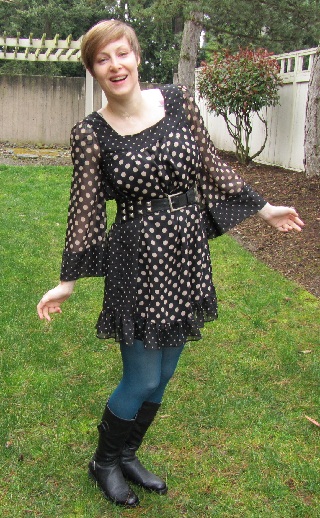
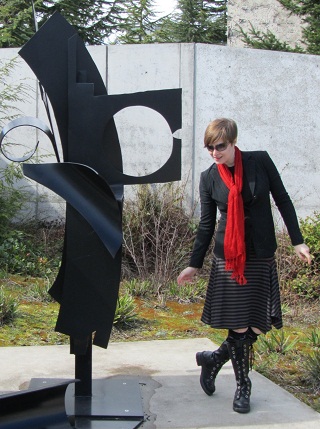
I’m wearing pants to work today—mainly because I can. Women’s clothing is often political and I’d like to look at a few examples throughout history. Some of it recent. This post is the fourth installment of the Feminist Fashion Bloggers weekly posts celebrating Women’s History Month. Check out what everyone else wrote about.
To this day, many women around the world aren’t allowed to wear pants. As recently as 2009, Sudanese officials handed out corporal punishment to thirteen Sudanese women; the women were arrested in a restaurant in the capital, Khartoum. They received 10 lashes each for their crime of wearing pants.
Ah, but that’s a different culture, you say. True, but not until January 1995 did the California legislature actually prohibit employers from implementing a dress code that does not allow women to wear pants in the workplace. That means, before then, employers could tell women “dresses only” and there wasn’t a damn thing they could do about it.
It’s not fair to make generalizations. Throughout history and in different cultures, clothing has changed a lot. For most of history, men didn’t wear pants either. They wore robes, tunics, kilts, dolmans, hakama, dhoits, sarongs, the fustinella, you get the idea. When men wear “skirts” (outside of the west—with the exception of kilts), it’s not seen as feminine. But when women wear pants, it’s perceived as somehow upsetting the whole balance of things.
However, the horse-riding peoples—men and women—of the Persian Empire wore pants as early as 600 BCE. Koreans of both genders wore pants as early as the 15th century. Many Native Americans wore leggings too.
Other women throughout history have been mocked and persecuted for their adoption of “men’s clothing.” Joan of Arc was known for wearing pants; she traveled with the army and wore their attire. She wore pants in prison and was said to have been executed in them. A few weeks ago I wrote about Qiu Jin, modern China’s first feminist. She chose to wear men’s clothing, much to the chagrin of onlookers.
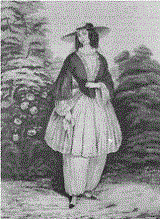 In the west, pants had a hard time getting a foothold.
Amelia Bloomer gets the credit, but Elizabeth Smith Miller created bloomers. These women were involved in women’s rights, temperance, abolition, and were social activists. They were also ridiculed by their attempts to reform women’s clothing.
During this time, some women advocated other changes too, such as simplified garments for bicycling or swimming. The availability of inexpensive bikes helped women gain independence and created a need for more practical clothing. Corset controversy began (and in China, Qiu Jin was unbinding her feet and fighting against that practice).
Nineteenth century coal-mining girls wore trousers, and throughout the world war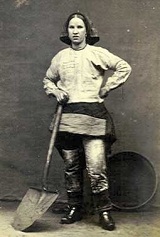 s working women donned slacks—but they didn’t come into fashion until later. Marlene Dietrich and Katharine Hepburn caught the world’s attention by wearing pants. Audrey Hepburn popularized capris. The 1960s introduced us to bell bottoms. The 1970s brought us pantsuits, and the rest is herstory.
Pants are political. As much as I like dresses, I am thankful for pioneers who fought for the right to choose one’s attire. Women’s clothing has been seen as a threat at so many points throughout history—and still is. Exercise your right today!
Sources:
http://www.csub.edu/library/gov/edocs/womenequality.pdf
http://news.bbc.co.uk/2/hi/africa/8147329.stm
http://en.wikipedia.org/wiki/Pants
http://en.wikipedia.org/wiki/Amelia_Bloomer
http://en.wikipedia.org/wiki/Bloomers_(clothing)
http://en.wikipedia.org/wiki/Women_wearing_pants
























 jeanofalltrades